Ariel Osborne Chaney 2026
Radegonde Lambert was born around 1621. And in the four centuries since, historians, genealogists, and DNA scientists have argued about where she came from, who her mother was, and whether the records we have are even about the right woman. She is the 9th great grandmother in this line.
Her name is a clue, or at least it might be. Radegonde (pronounced like RAH-deh-gond) is a Germanic name meaning “the one who decides to fight.” It was brought into French culture through Saint Radegonde, a sixth century Thuringian princess who became queen of the Franks, left her husband, founded a monastery at Poitiers, and spent the rest of her life in service to the poor. She was canonized in the ninth century and is still venerated in Poitiers today. The city of Loudun, from which Radegonde’s father, Jehan Lambert, is believed to have come, is about 30 miles from Poitiers. Jehan naming his daughter Radegonde could have been him honoring the patron saint of the region he came from. That is not proof of anything, of course. But it is an interesting thread, and with Radegonde, threads are most of what we have.
Before we can understand her story, it helps to understand the world she lived in, because most people have never heard of it.

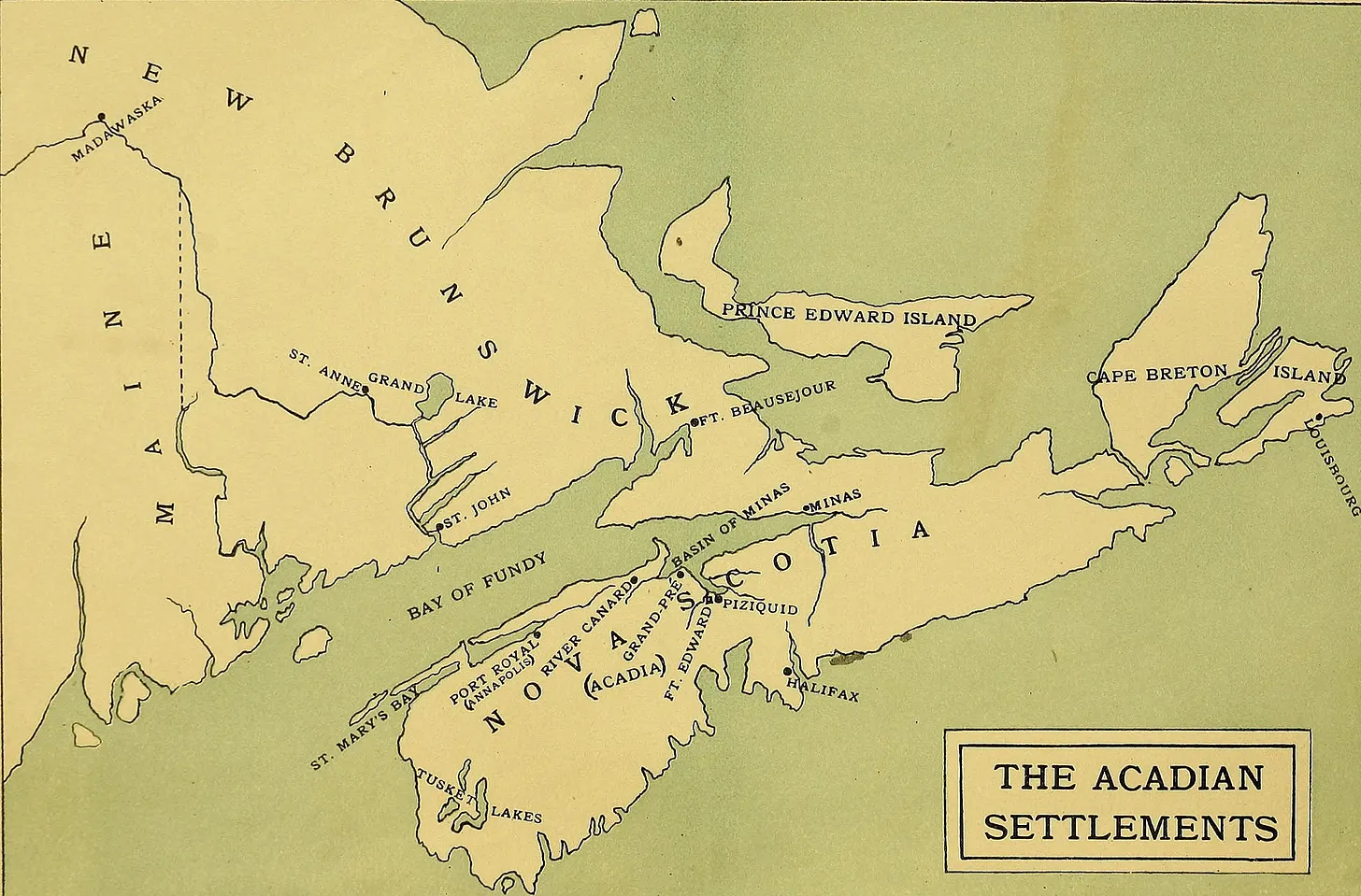
Acadia was a French colony established in 1604 on the eastern coast of what is now Canada, parts of present day Nova Scotia, New Brunswick, and Prince Edward Island. Its first permanent settlement, Port-Royal, was founded in 1605 in what is now Annapolis Valley, Nova Scotia. If you learned about early American colonization in school, you probably heard about the Pilgrims landing at Plymouth Rock in 1620. You probably did not hear much about the French settlers who had already been living in Acadia for fifteen years by then.
The difference between those two colonial experiences was significant. The English settlements in New England were ripe with conflict, displacement, and outright warfare with Indigenous peoples. The Acadians had a different kind of relationship with the Mi’kmaq, the Indigenous people who had lived in the region for at least two to three thousand years before any European arrived. The Mi’kmaq assisted the first French colonists at Port-Royal in 1605 and helped them survive.

In the years that followed, the two communities traded, formed alliances, shared knowledge, and in the earliest years of the colony, when French women were nearly impossible to find, intermarried. There are recorded marriages between Acadian settlers and Mi’kmaq women in formal Catholic rites. This was not the norm everywhere in North America. Acadia was different.
It is in this context that a French historical source makes a specific claim about Radegonde Lambert. A nineteenth century French Canadian historical document states directly that Radegonde was born of a union between Jehan Lambert and a Mi’kmaq woman, probably at Cap-de-Sable, Acadia, around 1628 or 1629. It explains that there were no French women available to marry in early Acadia, that Jehan Lambert and another settler took Mi’kmaq wives, and that mixed heritage descendants carrying the Lambert name were later found throughout the Acadian peninsula. The source further notes that Radegonde likely had brothers who continued living among Indigenous communities and married Indigenous women, accounting for the Lambert family names found among Acadian Métis families in later records.
This claim was widely accepted in Acadian genealogical circles for a long time, and it is easy to understand why. It made sense, I mean the context and history supports it.
But there’s one problem with it, and that’s DNA.
When descendants of Radegonde Lambert had their mitochondrial DNA tested, researchers expected to find Native American markers if the Mi’kmaq mother story was true. Mitochondrial DNA passes from mother to child essentially unchanged across generations, meaning it traces the maternal line directly back through time. What they found instead was a haplogroup called X2b4, which is entirely European. People carrying this exact DNA signature have been identified in England, Norway, Scotland, and Germany, in families whose ancestors have never left those regions. There are no Native American mitochondrial DNA matches for X2b4 anywhere in the world, in living people or in ancient burials. The science is consistent. Radegonde Lambert’s mother was not Mi’kmaq.
What the DNA cannot tell us is who her mother actually was.
A record from the Berry region of central France shows a Jehanne Lambert born January 15, 1625 in Aubigny, to a Jehan Lambert and a Marie Arthonne. I’ve noticed some researchers have connected this to Radegonde. But there are immediate problems with this record. Berry is not near Loudun. The name is Jehanne, not Radegonde. And a birth year of 1625 doesn’t align well with other records consistently placing Radegonde’s birth around 1621. Find A Grave seems to have combined these two women into a single entry, listing the name as Jeanne Radegonde Lambert as though it were a first and middle name. No other record I’ve found does this. It doesn’t necessarily mean it’s wrong, but I haven’t found anything at all to back this up.
A nineteenth century document collection, the Collection de Documents Inédits sur le Canada et l’Amérique published in 1890, noted that even at that time historians were already wrestling with a contradiction in the Blanchard family record. Some declarations named Guillaume Blanchard and his wife Huguette Poirier as the founding couple of the family, while the census records consistently named Jean Blanchard and Radegonde Lambert. The document concluded that since the censuses were written at the time the people were living and repeat the names consistently across multiple records, their testimony cannot be dismissed. Jean Blanchard and Radegonde Lambert are who they say they are. But the contradiction had already been noted and debated for over two centuries before we started asking questions. Jean’s parents are unknown.
Father Anselme Chiasson, an award winning Acadian historian, ethnographer, and Catholic priest who spent decades documenting Acadian history and folklore, references the Blanchard family and Radegonde Lambert in his respected work on Acadian history and traditions. His inclusion of her in his scholarly work confirms that she is recognized as a foundational figure in Acadian genealogy, whatever her origins.
What we know for certain is this: Radegonde Lambert married Jean Blanchard around 1642, most likely in Acadia, and had their first child around 1643. The 1671 census of Port-Royal records Jean Blanchard, age 60, with his wife Radegonde Lambert and their six children: Madeleine 28, Anne 26, Martin 24, Guillaume 21, Bernard 18, and Marie 15. Three of the six are already married. The 1686 census finds the couple alone, their children grown and settled into their own lives across Acadia. Jean died that year. Radegonde’s actual death date is unrecorded, but according to the Acadians Project she died before 1693 in Port-Royal.
Their children and grandchildren built lives across Acadia, but those lives would eventually be shattered by outside forces. In 1755, nearly a century after Radegonde’s last child was born, the British ordered the forced removal of the Acadian people in what became known as Le Grand Dérangement, the Great Upheaval.

Between 11,000 and 18,000 Acadians were forcibly removed from their homes, their lands seized, their villages and churches burned to prevent their return. Families were separated, many never reuniting. Thousands died at sea or from disease in overcrowded ships. It was described by some historians as the first attempt at ethnic cleansing in North America, and it was the opening act of what would become the French and Indian War.

Two of Radegonde’s children, Madeleine and Marie, are listed on Find A Grave as buried at Garrison Graveyard in Annapolis, Nova Scotia, the same location where Radegonde and Jean are noted. A photo submitted by Anita G. for Madeleine’s memorial shows not headstones but a grassy mound, with a note from Anita G. explaining that this is the location of an Acadian burial and that all headstones of the family were destroyed by the British. Their son Martin is believed to be buried at St. Peter & St. Paul Parish Cemetery in Cobequid, now Masstown, Nova Scotia. The church, the cemetery, and all surrounding buildings were burned by British soldiers in 1755 to discourage Acadians from returning. Today it is a grassy field with a large blue historical marker.


The headstones of Radegonde and her family may be gone, but her life was significant, and her story lives on.
If you have information about Radegonde Lambert, Jehan Lambert, or the early Blanchard family of Port-Royal that goes beyond what is documented here, I would love to hear from you! This is one of those times the key might come down to a piece of information someone else is holding.
I’ve added some photos for some visual context.
We have the Acadian Settlements map so you can see exactly where Port-Royal sat in relation to the world Radegonde lived in. From An Historical Sketch of the Acadians, George P. Bible, 1906. Library of Congress. No known copyright restrictions.
The Mi’kmaq encampment painting gives a sense of the landscape and the people who were already there when the French arrived. Nova Scotia Archives, via Flickr Commons. No known copyright restrictions.
The painting of La Déportation des Acadiens, Henri Beau, 1900. Public domain.
Grand Dérangement monument, Prince Edward Island. Photo by Erie Bard, Wikimedia Commons, CC BY-SA 4.0.
And the final two photos are from Anita G., who submitted them to Find A Grave: the grassy mound at Garrison Graveyard in Annapolis where Radegonde and Jean are believed to be buried, and the plaque listing the families of the 1671 Acadian census. You can find both Lambert and Blanchard both on it.
Leave a Reply