Ariel Osborne Chaney 2026
Polina Buell was 14 years old when her family traveled the Oregon Trail.
She was born January 23, 1833 in Vevay, Indiana to Elias Buell and Sarah Hammond.

In 1847, the Buell family joined the tide of families pointing their wagons west toward Oregon. They settled near The Dalles in northern Oregon, where Elias had heard a new government mint was planned to be built. He decided to build a grist mill instead, and hired a young Englishman named Daniel C. Rowell to work it. Daniel had arrived in Oregon on September 28, 1850, before his 18th birthday, and held Donation Land Claim number 2721. He was a miller by trade. That is how he met Polina. They married in February of 1851 in Polk County, Oregon. By 1860 the family had settled in Buena Vista, Wisconsin, where the census found them with three sons, Elias H., age 8, Henry C., age 7, and Charles M., age 2. A fourth son would follow.
In 1865, Daniel and Polina decided to sell their farm and return to Oregon to be near her parents. They hadn’t told Elias and Sarah yet. They wanted to surprise them with the grandchildren, who her parents had never met. Polina, practical and careful, stitched the gold coins from the farm sale into the hem of a dress for the journey. They booked passage on the Steamer Brother Jonathan.

The Brother Jonathan had been making the run between San Francisco, Portland, and Victoria, British Columbia for years.
For its final voyage the ship was dangerously overloaded. Captain Samuel DeWolf had serious concerns before the ship even left the dock. According to his widow, he felt the ship sat too low in the water even before the passengers boarded, but when he raised the issue he was told plainly that if he refused to sail he would be fired and replaced by someone who would. When it came time to depart, the hull had sunk so deeply into the mud that the ship had to wait for high tide and a tugboat to pull her free. The cargo holds were packed with over 700 tons of merchandise, heavy mining and railroad equipment, and an ore crusher. A large ship’s safe held jewelry, gold coins, and gold bars. Crates of gold coins had been loaded for Wells Fargo shipments bound for Portland and Vancouver, along with the annual treaty payments in gold owed to Indigenous tribes. Also aboard was William Logan, the newly appointed Superintendent of the U.S. Mint in The Dalles, the very mint that had drawn Elias Buell to Oregon in the first place. The gold alone, by today’s value, amounted to roughly $50 million. The ship left San Francisco carrying 244 passengers and crew.
Within hours the Brother Jonathan ran into a gale. Most passengers became deathly seasick and retreated to their cabins. On the morning of Sunday July 30, 1865, the ship anchored in Crescent City harbor to offload cargo and take on coal, mail, and supplies before continuing north. It left the bay at 9:30am and steamed directly into a worse storm.

By 12:45pm conditions had become so dangerous that Captain DeWolf, at the urging of passengers, turned the ship back toward the relative safety of Crescent City bay. The Rowell family was in second class, huddled together. At 1:50pm the Brother Jonathan struck a hidden volcanic peak, impaling her keel with a jolting crash. The damage was catastrophic. The ore crusher loaded in the hold had been placed directly above a section of hull that had been repaired just a month earlier, and the impact drove it straight through. Enormous waves continued to crash over the stationary ship. Within five minutes Captain DeWolf knew the ship was going down and ordered everyone to abandon ship. There were enough lifeboats on board to carry every soul. Only three could be deployed in time. The first was capsized immediately by the waves. The second was smashed against the ship’s hull. Four boats in the harbor attempted to reach the Brother Jonathan but were driven back by the storm. Acts of courage and desperation played out across the deck as the ship went under. Only a single surfboat made it to safety, carrying eleven crew members, five women, and three children to Crescent City. Of the 244 passengers and crew, 225 died.

When the ship struck the rock the Rowell family emptied their chest. Polina put on her hemmed dress with the gold coins sewn inside. Daniel strapped the chest to her back. She held two of the boys while he clutched the other two. The chilling ocean surged over the stern where they stood. They did not make it to a lifeboat. A survivor named Mary Tweedale Garretson later recalled the Rowells: “That sweet family, father, mother, standing on that pitching deck, their little ones clutched about them, the wind and spray lashing at their clothing, and she, that beautiful woman, gazing down at us so wistfully as we pulled away.”
When Oregon newspapers first published the names of the dead they printed the family name as Powell. Elias and Sarah Buell, waiting in The Dalles, still thought their daughter was on her way. When the correction ran and the name read Rowell, Elias hitched his team to his wagon and drove alone from Oregon to northern California. When he arrived in Crescent City and learned that only one surfboat had survived, he drove north along the coast, searching.
After days of looking he came upon two men picking at something along the waterline. As he rode closer they ran. He got down to investigate and found them working at gold coins stitched into the hem of a skirt. Beneath the skirt was a body, pinned under a strapped chest. When Elias turned the chest over he saw the face of his daughter.

He fell to his knees. Whether the scavengers had taken any of the coins before Elias arrived, whether she was buried with what remained, whether he carried any of it back to Oregon, nobody recorded. That part of the story the ocean kept. He loaded Polina into the wagon. Some distance away he found Daniel.

Further on, a small bundle of clothing on the beach, a child the right age and size. Having never met his grandchildren he could not be certain, but he added the child to the wagon. In the Crescent City morgue he found three more small bodies of the right age and sex and claimed them all as his grandchildren. He did not want the family separated. He buried all six together on the mesa in Crescent City, in the plot where other Brother Jonathan casualties were laid to rest. Then he turned his wagon north and drove home to Sarah. Daniel and Polina’s headstones still stand in the Brother Jonathan Cemetery on the ocean bluffs at the end of 9th Street in Crescent City, California, a site now listed on the National Register of Historic Places and recognized as California Historical Landmark No. 541. They are among the most noted of the 28 headstones there. Polina’s stone reads that she was 22 years old. She was 32. The stone is wrong, but she is not forgotten.
William Logan, the man who was to oversee the Dalles mint, did not survive either. The mint was never completed.
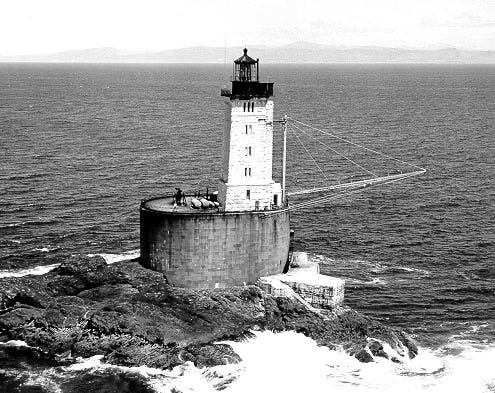
The wreck of the Brother Jonathan changed maritime safety regulations in the United States. In the years that followed, new regulations were passed requiring that lifeboats be capable of being launched from a sinking ship. The disaster also prompted the construction of a lighthouse on the very rock that sank her.

St. George Reef Lighthouse was completed in 1892, twenty seven years after the wreck, at a cost of $752,000. Built on a rock only 300 feet in diameter six miles off the coast of Crescent City, it required 1,339 dressed granite blocks quarried from Mad River near Humboldt Bay and took nearly a decade to complete. It is one of the most expensive and difficult lighthouses ever built in American history, and today can only be reached by helicopter.
The Brother Jonathan herself was not found until 1993, lying on the ocean floor two miles from where she struck the rock. A portion of her gold was recovered in 1996. In the 1930s a fisherman had quietly pulled 22 pounds of gold bars up in his nets. Because it was illegal to own gold bars at the time, he said nothing for decades, finally selling them in 1974.
The Brother Jonathan has been at the bottom of the Pacific Ocean for 160 years. Elias Buell drove home to tell his wife. The grandchildren he buried may or may not have been his. And somewhere in the wreck, or along that northern California coastline, there may still be gold coins that were never meant to be there at all.
I’ve added photos of the lighthouse, the memorial stone, sketch of the ship, Polina and Daniel’s headstones and a photo of Elias.
Leave a Reply