Ariel Osborne Chaney 2026
Margaret McQuick was born around 1820 in County Antrim, Ireland. She lived in or near Ballymoney, a market town in the north of the county, sitting inland from the Antrim coast in the heart of Ulster farming country. It was Protestant country, Ulster Scots country, where the land was worked by families who had been there for generations but rarely owned the ground beneath their feet. Tenant farmers paid rent to landlords and hoped the harvest was enough to cover it. Margaret couldn’t write, which tells us something about the world she grew up in. Literacy was not a given for a woman of her station in rural Ulster in the 1820s and 1830s. What she knew, she learned by doing.
Sometime around 1834 she married a man named James Osborne. In 1835 they had their first child, a son named John. Five more children soon followed: James, Nancy, Mary, Alexander, and then Andrew in 1848. Six children in all, born,in or around Ballymoney, in one of the most devastating times of Irish history.
The Great Famine began in 1845 when the potato crop failed across Ireland. By 1847, the year that came to be called Black ‘47, it had become catastrophic. A million people would die. Another million would leave. The failure of the potato crop was a natural disaster, but what followed was not entirely one. While the Irish starved, food continued to be exported out of Ireland under British law. Landlords, many of them English and Anglo-Irish, evicted tenant farmers who could no longer pay rent rather than reducing it. The British government’s response was slow, inadequate, and shaped by an ideology that treated Irish suffering as a problem the Irish had brought upon themselves. The Famine killed at least one million people. British policy decisions ensured it killed as many as it did. Even in Antrim, which fared better than the devastated west and south, people were suffering, displaced, and desperate. Families were separated. Tenant farmers with no land of their own and nothing saved had almost nowhere to turn. Many ended up in the workhouse, the last resort of the destitute, where families were separated, fed barely enough to survive, and put to work in exchange for a roof.

The Ballymoney workhouse register from 1843 to 1849 contains nearly five thousand names.

Margaret and her children could have been among them, but the records have not yet confirmed. Some of those records are not digitized. Others sit behind paywalls or simply didn’t survive. The search continues.
What we know is this: sometime between 1847 and 1851, James Osborne died. We don’t know the cause or the exact year. We know that Andrew, the youngest, was born in 1848, and by 1851 Margaret was listed as a widow on the Canadian census. James was gone before she ever left Ireland. Whether the Famine took him directly, or whether illness, or something else entirely, nobody knows. Margaret would never remarry, and navigated life as a widow.
In 1851 she boarded the J & J Cooke, bound for Quebec, with six children. The ship manifest lists her as Osborne, Margaret, address Ballymoney, with her children beside her: James, age 12. Nancy, age 10. Mary, age 8. Alexander, age 6. Andrew, age 2. John, age 12. James and John are both listed as twelve, which is not a clerical error so much as a reflection of biology. They were what people called Irish twins, born one right after the other one.
The average crossing took five weeks. One in five passengers on ships like the J & J Cooke died at sea from disease or malnutrition. The ship passed through Grosse-Île, the quarantine island in the St. Lawrence River where Irish immigrants were inspected before being allowed to continue into Canada. Over six thousand Irish are buried on that island.

A Celtic cross still stands there, its Gaelic inscription reading:
Cailleadh Clann na nGaedheal ina míltibh an an Oileán so an dteicheadh dóibh ó dlighibh na dTiarnacht nGalldha agus ó Gorta Thréanach in na bliadhantaibh 1847-48. Beannacht dílis Dé orra. Biodh an leacht so i gcomharta grátha agus onóra dóibh ó Ghaedhalaibh Amherica. Go saoraídh Dia Éire.
Or
Children of the Gael died here in their thousands on this island having fled from the laws of the foreign tyrants and an artificial famine in the years 1847 to 1848. God’s loyal blessing upon them. Let this monument be a token to their name and honor from the Gaels of America. God Save Ireland.


Margaret and her six children were not among the dead. They made it through.
They settled in Elgin, Ontario, and all six children had made it. Whatever the crossing had cost them, it had not cost them each other.
The census records from those years show a woman holding her household together. In 1851 she is listed as head of household and Presbyterian. By 1861 her son James appears above her in the record, and the Episcopal Methodist denomination marked for the household appears to reflect his faith rather than hers. By 1871 she is head again, and Congregationalist. What the 1871 census also records is that she still could not write. She had raised six children across two countries without ever being able to sign her own name.
The children she had carried across the Atlantic built lives of their own. John married Jane Farrah. Mary married a man named Joseph Horton. Andrew, the youngest, the two year old on the ship, married a woman named Martha in 1879 and would eventually make his way to Michigan. James, Nancy, and Alexander are present in the 1861 census and then silent. Where they went, who they married, whether they stayed in Canada or moved on, the records haven’t been found. If you recognize those names in your own research, I’d love to hear from you!
Andrew heard there was good land to be had in Michigan, so he crossed the border, bought forty acres in Kingston Township in Tuscola County, built a house for his family. Sometime around 1880, Margaret followed them. She was approximately sixty years old. She had already crossed an ocean. Michigan wasn’t the hardest thing she’d ever done.
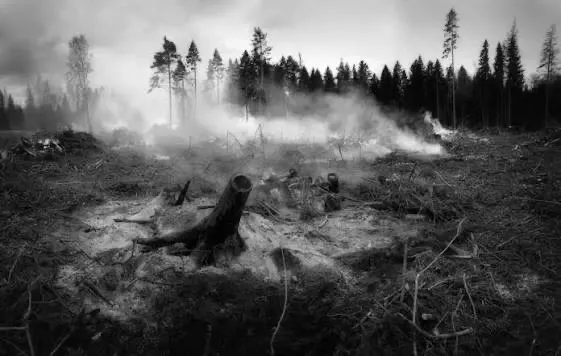
The summer of 1881 was brutal in ways that people in the Michigan Thumb wouldn’t fully understand until it was too late. There had been no significant rain since April. Wells were running dry. Streams had gone quiet. The swamps had burned down to hard clay under a sun fiercer than anyone could remember. The forests and the fields were tinder, and the earth itself was cracked open with thirst. Decades of logging had left mountains of slash and brush across the land, and farmers burned it to clear it away, just like they always had, because no one could predict what was coming.
On the morning of September 5th, 1881, the sky over Kingston Township was clear at sunrise.
By one o’clock in the afternoon it had turned copper.
By two o’clock it was so dark that people were lighting lanterns outside just to see where they were going.
A mid-Atlantic cyclone had driven hurricane force winds in from the southwest, and every small fire burning across the Thumb became one fire.

A witness would later describe what came as a solid wall of flame fifty to a hundred feet high rushing down the ridges. It burned over a million acres in less than a day. It killed 282 people across Sanilac, Lapeer, Tuscola, and Huron counties.

The smoke climbed high enough into the atmosphere to obscure sunlight on the East Coast of the United States. The following day became known as Yellow Tuesday, for the strange luminous color the sky turned over New England.
Margaret and Martha were together when it reached their home. Andrew was away at work. It was just the two women and Martha’s young son James, and a wall of fire moving toward the house.
Instead of running, the girls went to the well. They drew water and soaked the house the best they could. When sparks landed they beat them out with water soaked clothing. They worked until the fire passed and the house still stood.
Martha never forgot it.

She carried that memory for the rest of her life, which turned out to be a very long one. She died in 1960 at the age of 104, the oldest resident of Tuscola County and the last known surviving witness of the Great Thumb Fire of 1881. She was still clear in her recollection of it at the end.

Margaret did not have as many years left. She died in Kingston Township in 1885, four years after the fire. Her death record lists the cause as old age. She was somewhere in her mid-sixties, though her exact birth year was never precisely recorded. Her death record names her father as James McQuick, the only document that does. Her husband was James Osborne. Her name was spelled differently on nearly every record that mentioned her.: McQuick, McQuesty, McQuidy, McQuilkin, depending on who was holding the pen, and who how they interpreted or anglicized the pronunciation of her surname. None of that changes what she did.
She married in Ballymoney and likely buried her husband there. She got six children across the Atlantic alone. She raised them in a country that wasn’t hers, without being able to write her own name. She followed her son to Michigan when she was sixty years old. And when a wall of fire came for the house in Kingston Township, she went to the well.
If you have information about Margaret McQuick, James Osborne, or the Osborne family in County Antrim or Middlesex County, Ontario, I would love to hear from you.
Photographs and documents have been included to provide visual context for Margaret’s story, from the world she left behind in Ireland to the land she made her home in Michigan. Also included is the obituary of her daughter-in-law Martha Osborne, whose firsthand memory of the Great Fire of 1881 is the closest account we have of that day, and a photograph of Martha herself.
The Irish Famine, Scene at the Gate of the Work-House.” Illustrated London News, 1846-1850. Public domain.
Antrim workhouse entrance block from the north-west, 2003. Photo by Peter Higginbotham. workhouses.org.uk.
Monument to the Irish immigrant victims of typhus, Grosse-Île, QC, about 1910. Notman Photographic Archives, McCord Museum, MP-0000.1255.9. Flickr Commons. No known copyright restrictions.
Celtic Cross, Grosse-Île, Quebec, 1909. Photo by Rachel Garber. Irish Heritage Quebec, 100objects.qahn.org.
Great Fire of 1881 Michigan Historic Site marker, Brown Roadside Park, M-25 near Bay Port. Photo by J. J. Prats, September 22, 2023. Historical Marker Database, hmdb.org.
Photo by Larry Gertner, New York. Historical Marker Database, hmdb.org, December 8, 2022.
Historical Society of Michigan, Facebook, September 5, 2025.
The Saginaw News, Saginaw, Michigan. Newspapers.com.
Family picture of Martha Osborne
Leave a Reply