
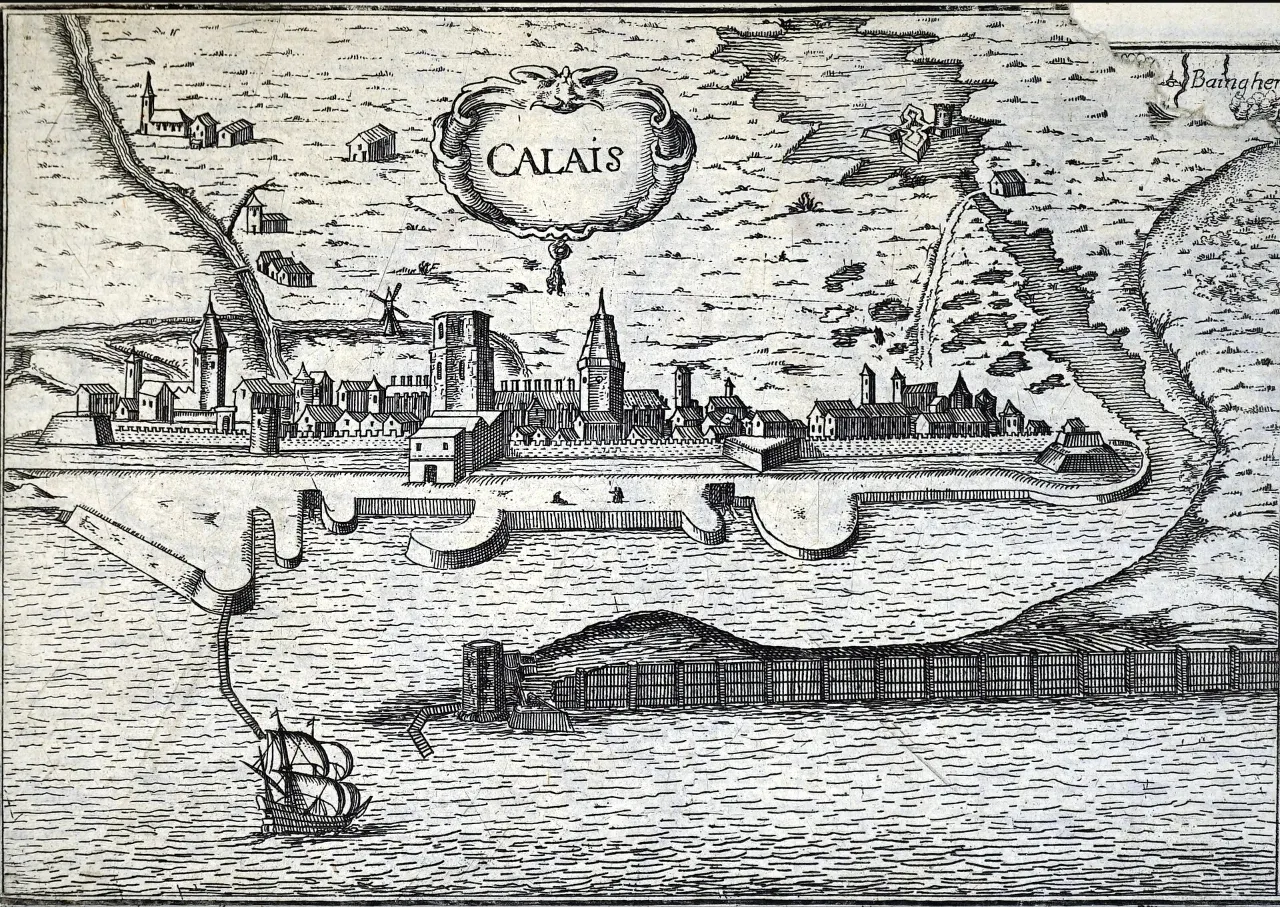
Philippe Casier was born around 1616 in Calais, a port city on the northern coast of France.

His family was Huguenot, French followers of the Protestant reformer John Calvin. They were more than a religious minority. Their churches operated independently of Catholic authority, making them a political concern for the French crown as well as a religious one. By the time Philippe was a young man, leaving France for somewhere safer wasn’t unusual for a family like his. It was often necessary.
In 1635 he joined a group of experienced settlers moving from the island of St. Christopher, in the Caribbean, to a newer Huguenot settlement on the island of Martinique.

Both islands were part of what was then called the French West Indies, a name for France’s Caribbean colonies during this period. Martinique is still a French territory today. Philippe married a woman named Marie Taine either just before this move or shortly after arriving, and the couple’s first 2 children, Jean and Marie, were born on the island.
He stayed about a decade. By 1645 the conditions on Martinique had become difficult enough that Philippe and others simply left. The colony there was struggling, badly governed, and increasingly hard to live in. One account describes Philippe as having grown tired of “the rough pioneer life” and another notes “the anarchy which reigned in the islands” as the reason settlers gave for going. Whatever the precise cause, a man who had crossed an ocean once to build a new life had decided it wasn’t working, and crossed back.
He returned to Calais, then moved on to Sluis, a town in the historical region of Flanders, where his daughter Hester was born. Flanders was never a country of its own, but a region whose borders shifted over centuries between what’s now France, Belgium, and the Netherlands. Sluis itself sits today in the Netherlands, in the province of Zeeland. From Sluis the family traveled inland, up the Rhine, the major river running through what is now Germany, Switzerland, and the Netherlands, to the city of Mannheim.

Mannheim sat within the German Palatinate, a territory along the Rhine that had been devastated by the Thirty Years’ War, a conflict that had only ended in 1648. The Protestant elector who ruled the region afterward offered safety and land to refugees fleeing persecution elsewhere in Europe, and by the 1650s, Mannheim had become a gathering point for exactly the kind of people Philippe was: French and Walloon Protestants who had already been displaced once and were looking for somewhere that might finally hold.
It didn’t hold for long. Philippe’s wife had a brother, Isaac Taine, who had gone ahead to the Dutch colony of New Netherland years earlier and had been made a burgher, meaning he’d earned full citizenship rights in the city of New Amsterdam, what is now Manhattan. With that example ahead of him, and with a region still recovering from decades of war at his back, Philippe decided to try once more. He and his family traveled back to the Netherlands and boarded a ship called the Vergulde Otter, the Gilded Otter, which left the harbor at Texel, a Dutch island and major departure point for ships crossing the Atlantic, on April 27, 1660.
The ship’s passenger record survives.

It lists him as “Philip Cassier, farmer from Calais, wife and 4 children.” Those 4 children were Jean, about 23, Marie, about 16, Hester, about 12, and the youngest, Jacques, about 3. A 5th child, Sarah, hadn’t been born yet. She would come 2 years later, in Harlem itself. Also aboard that same crossing was a young soldier named Jacob Leisler, who would go on, 30 years later, to lead a rebellion in colonial New York and be hanged for treason. Philippe and Leisler shared a deck for weeks. Their lives afterward had nothing else in common.
The family arrived in June 1660 and settled in Harlem, then a small farming settlement on Manhattan Island, not yet anything resembling a city. Philippe went to work right away, recorded as cutting timber. By March 1662 he was petitioning alongside other settlers for land and received a grant of 24 morgen, a Dutch unit of land measurement equal to roughly 2 acres each, for a total of about 48 acres. That same year he bought an adjoining lot on Van Keulen’s Hook, complete with a house and meadow, sitting directly beside the land he already held.
He became one of the more trusted men in the young settlement. On April 28, 1662, he and a neighbor named Lubbert Gerritsen were named legal guardians of 2 children, Carsten and Griete Sneden, after the children’s parents became the first residents of the settlement to die. What that guardianship looked like isn’t recorded. Whether the children lived in his household or whether he simply oversaw their interests, the community trusted him enough to give him that responsibility.
On October 2, 1662, he and Marie formally joined the Harlem church as members, a step beyond simply attending services that marked full standing in the religious community. On November 16, 1662, Philippe was appointed schepen, a town magistrate, responsible for local governance and disputes. On January 11, 1663, he sold his lot on Van Keulen’s Hook to a man named Jacob Eldertsen.
He didn’t get to hold the office long. By April 23, 1663, his magistrate’s seat had to be filled by another man, Michiel Muyden, because Philippe had died. He had served barely 5 months.
James Riker, writing decades later in his Revised History of Harlem, recorded what the community lost. “Philippe Casier, had he lived, must have proven a most useful inhabitant,” he wrote. “His adventurous voyage from France to the West Indies, back to Holland, thence up the Rhine, and finally to this country, with his eight in family, are events in his life already noticed.” Riker called him “one of its sterling men, a skilful farmer, and valued for his experience and judgment.” Harlem lost Philippe and another respected settler, Adam Dericksen, within a short stretch of the same season, and felt both losses deeply.
Marie outlived him by more than a decade. She sold their remaining land to a neighbor, Joost Van Oblinus, and bought a house in New York, where she lived for some years with her sons Jean and Jacques, both of whom had become bakers. In 1671 Marie married again, to a widower named Jean le Roy of Harlem, and moved with him to Staten Island. Her surviving children built their own lives across the colony: Jean farming on Long Neck, Sarah marrying a merchant from St. Martin, Hester marrying into the Belleville family, and her oldest daughter Marie marrying a man named David Uziele, whose own family had crossed the Atlantic on that same ship, fleeing that same instability, the same year. Jacques, the youngest child carried aboard the Vergulde Otter, died around 1673, at only about 16 years old.
The Casier name shifted over the generations that followed, spelled at different times as Cassier, Cazier, and Casey. One historian, tracing the descendants forward, asked the question outright: has not this name become Casey?
Philippe Casier crossed an ocean, found it wasn’t enough, crossed back, tried again over land, and crossed the ocean a second time. He spent much of his life looking for a place where his family could stay put. France hadn’t offered it. Martinique hadn’t offered it. Mannheim hadn’t offered it.
Harlem finally did.
In that short time he became a landholder, a church member, a guardian to 2 children who weren’t his own, and a magistrate trusted by his neighbors. Five months after becoming a magistrate, he was gone.
The journeys continued without him. His wife lived on. His children married. His descendants spread across New Netherland. But Philippe was the one who carried them there.
If you’re related to Philippe Casier, Marie Taine, or any of their children, Jean, Marie, Hester, Jacques, or Sarah, or if you have documentation, photographs, or family stories that could add to this account, I’d love to hear from you!
Pictures:
Calais, 1634. Tassin. Wikimedia Commons.
Martinique. Map, Emery Walker. Wikimedia Commons.
Belagerung und Einnehmung der Stadt und Vestung Manheim, Anno 1622. Wikimedia Commons.
The State Barge Saluted by the Home Fleet. Jan van de Cappelle, 1650. Wikimedia Commons.
Leave a Reply