
Ots-Toch was born Kanien’kehá:ka at Canajoharie, sometime around 1620. The Dutch colonial administration of New Netherland kept records about trade, land, disputes, and diplomacy with remarkable consistency. Her name isn’t in any of them.
“Ots-Toch” first appears in writing in the nineteenth century, drawn from oral tradition by historians already looking backward across two hundred years. She appears in various sources as Otstock, Alstock, and Owasto’k, that last spelling suggesting the glottal stop characteristic of Kanien’kehá:ka phonology. How her name sounded for sure is unknown. Whatever name she went by among her own people, whatever Cornelius Van Slyck called her when he came to live in her village, it didn’t survive in the documents. She appears in those records only as she appears in most records of her era: indirectly, through the men around her. And yet she is one of the most consequential Indigenous women in the surviving history of early Dutch and Mohawk relations, which makes her absence from the record something worth sitting with.
Canajoharie was one of the principal longhouse villages of the Kanien’kehá:ka, the easternmost nation of the Haudenosaunee Confederacy, known to Europeans as the Iroquois or Five Nations.

The Haudenosaunee were among the most politically sophisticated peoples in North America. They were also matrilineal. Clan identity passed through the mother. Longhouses belonged to the women who lived in them. Property and lineage moved through the female line, and the Clan Mothers held the authority to appoint and remove the sachems, the political leaders of the nation. This isn’t context. It’s the structure of everything Ots-Toch did.
Tradition identifies her as a member of the Turtle Clan and as the daughter of a chief. Whether those details are accurate or accumulated through generations of retelling, the life she lived suggests a woman of standing. Her family line held rights to land that moved through the maternal line.
Cornelius Antonissen Van Slyck arrived in New Netherland sometime in the 1620s or 1630s. He was Dutch, and he worked as an interpreter between the colonial administration and the Kanien’kehá:ka at a moment when that work was not incidental. New Netherland’s survival depended on maintaining fragile relationships with the nations whose territory surrounded it, and the people who could stand between those worlds and speak both languages were not replaceable. Cornelius was one of them. He came to Canajoharie, and he stayed. The people there gave him a name: Broer Cornelius. Brother Cornelius, suggesting a level of acceptance and belonging that outsiders rarely received.
They came together around 1635. There was no Dutch marriage ceremony, no church record. Canajoharie recognized their union, and that was what mattered. Cornelius didn’t bring Ots-Toch back to Fort Orange or any of the Dutch settlements. He lived with her, in the longhouse village, among her people. He continued his interpreting work and was treated with great respect. He had placed himself inside her world, not the other way around.
Ots-Toch didn’t convert to Christianity, and she didn’t raise her children within it either. Their first son, Jacques Cornelius, was born around 1640 at Canajoharie and carried a European given name, Jacques, alongside a Kanien’kehá:ka name, Itsychosaquachka. Another son, Marten Maurice, worked as an interpreter between the Kanien’kehá:ka and colonial society until his death in 1662. A daughter, Lea, born around 1646, also worked as an interpreter at Indian conferences at Fort Orange, and her signature appears on numerous colonial deeds. A daughter, Hilletie, later chose to live among the Dutch but served as an official interpreter for the colonial government, a woman who could move between both worlds because she’d been raised to understand them. Dutch settlers came to Canajoharie more than once, asking to take Hilletie and raise her among Christians. Ots-Toch refused. When they kept asking, she told them she would rather kill the girl than give her over. When Hilletie grew older and began to be drawn toward Christianity on her own, her mother pulled away from her. Her brothers and sisters threw stones at her. The family eventually made things difficult enough that Hilletie left.
What the record does confirm is that after her death, the island passed first to her son Marten, and then to Jacques when Marten died in 1662. A confirmatory patent issued October 30, 1684 officially records that Jacques held that land in right of his mother, who was a Mohawk woman.

Under Haudenosaunee law, in a matrilineal society, land passed through the female line. The island in the Mohawk River long associated with her family was not necessarily the only land tied to Ots-Toch or her children, but it is the piece the records preserve most clearly. This land moved through her lineage. Cornelius had access to it because of who she was. It was later named Van Slyck’s Island. It had been hers first.

In April 1680, a Dutch traveler named Jasper Danckaerts met Hilletie near Schenectady and recorded her account at length in his journal. He described her as “a half-breed,” the daughter of a Dutch father and a Kanien’kehá:ka mother. Hilletie told him her mother would never listen to anything about Christianity, that it was against her heart.


The French father story deserves mention because it’s been repeated for a long time in Van Slyck family genealogies. The tradition holds that a French trader named Jacques Hertel or Hartell came through the Mohawk Valley around 1620, fathered Ots-Toch and her sister Kenutje, and moved on. The problem is that the earliest written version of this appears in 1836, nearly two centuries after her death, compiled by a local historian from what he himself described as “segregated fragments and broken facts of unwritten traditionary history.” Danckaerts, who actually met her daughter and discussed her mother, said nothing about French blood. Contemporary records identify her as a Kanien’kehá:ka woman, and the Hertel story most likely grew in the telling the way legends do.
Her name, her clan, her father’s identity: all of it carries a question mark. What doesn’t is what she built. Her children became interpreters between the Haudenosaunee Confederacy and the Dutch colonial government at one of the most consequential moments in the early history of New York. They could move between those worlds because she had raised them in both. The land passed through her line because Haudenosaunee law said it should. Cornelius was Broer Cornelius because his acceptance into Kanien’kehá:ka society came through her community, and the structures that shaped it.
She lived and died in Canajoharie, and the Dutch records don’t name her in her death any more than they named her in her life. The island in the Mohawk River still carries her husband’s name on the maps.
If you’re related to, or have documentation on Ots-Toch or her children, I’d love to hear from you!
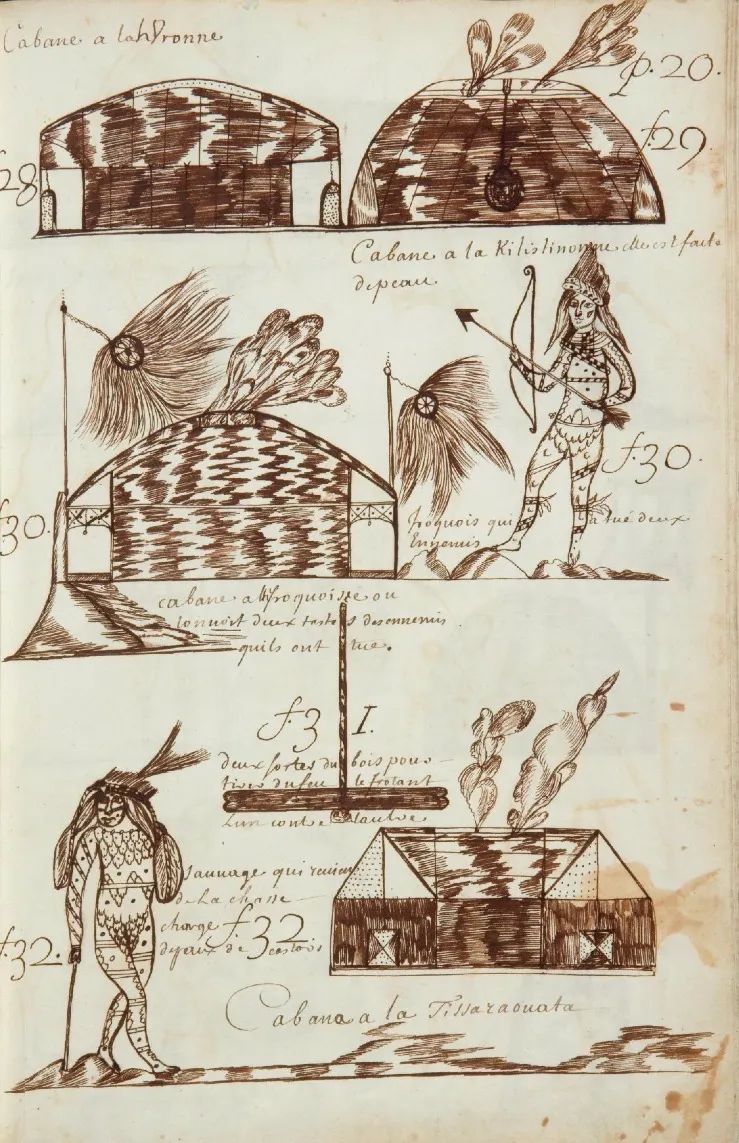
Louis Nicolas, Codex Canadensis, c. 1700, ink on paper, 33.7 x 21.6 cm. Gilcrease Museum, Tulsa, Oklahoma. Public domain. Via Wikimedia Commons.
Patent of 1662 for Van Slyck’s Island, Schenectady. Issued by Petrus Stuyvesant, Director General of the Province of New Netherland, to Jacques Cornelise Van Slyck and Jan Barentse Wemp.” From Nelson Greene, A History of the Mohawk Valley: Gateway to the West, 1614-1925. Chicago: S.J. Clarke Publishing Company, 1925. Original held at Union College, Schenectady, New York. Courtesy of schenectadyhistory.org. Public domain.
Bouwlands of Schenectady, 1664,” drawn for Maj. MacMurray. From Jonathan Pearson, A History of the Schenectady Patent in the Dutch and English Times (Albany, NY: J. Munsell’s Sons, 1883), pp. 58-59. Courtesy of the Schenectady Digital History Archive, schenectadyhistory.org. Public domain.
Jasper Danckaerts, Journal of Jasper Danckaerts, 1679-1680, ed. Bartlett Burleigh James and J. Franklin Jameson. New York: Charles Scribner’s Sons, 1913, p. 201-203. Public domain.
Leave a Reply